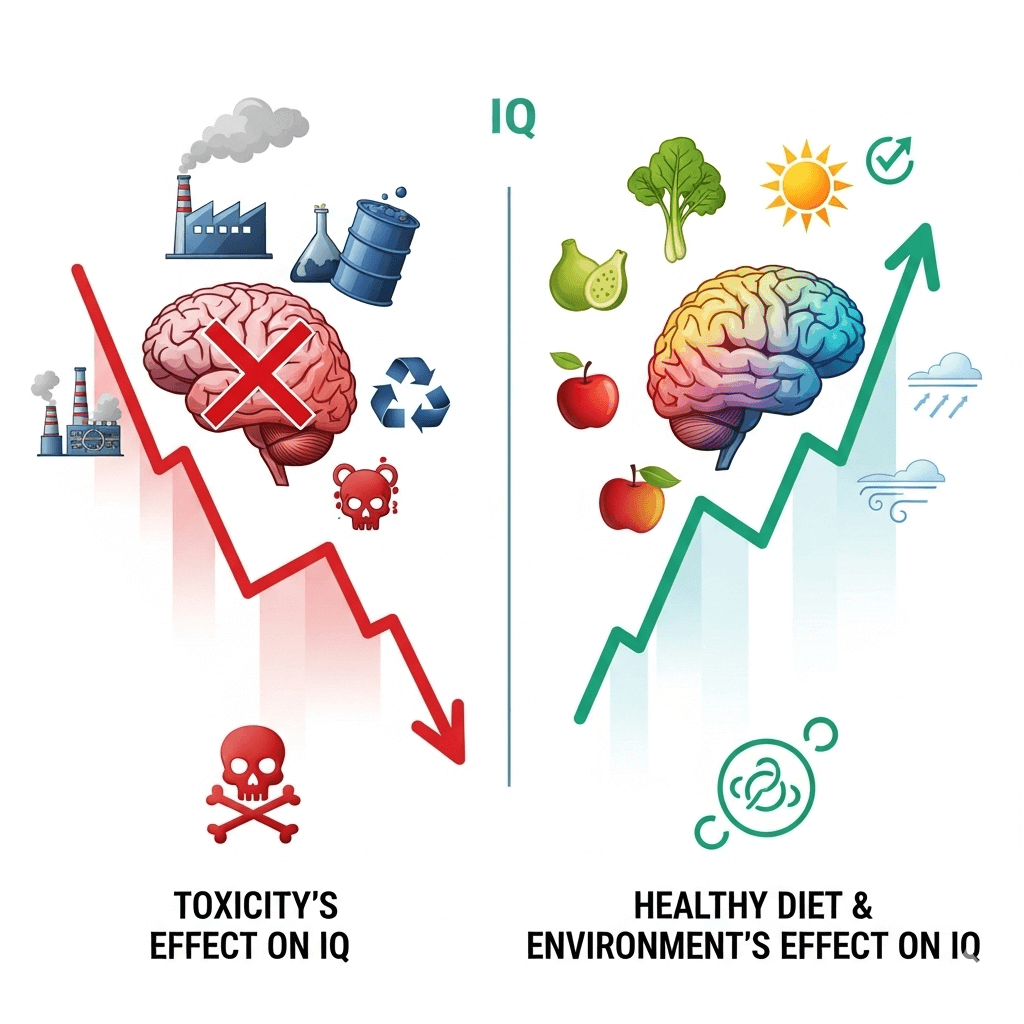

Intelligence is not fixed by genetics but profoundly shaped by environmental factors – a conclusion supported by decades of rigorous research across neuroscience, nutritional psychiatry, and environmental psychology. The most compelling evidence comes from the Flynn Effect, where global IQ scores have risen 2.31 points per decade due to environmental improvements, and from adoption studies showing IQ gains of 13-20 points when children move from deprived to enriched environments. This research definitively demonstrates that human cognitive abilities emerge from our deep integration with natural systems rather than existing in isolation from them.
Environmental factors override genetic determinism
The relationship between environment and IQ represents one of the most dramatic reversals in scientific understanding. Eric Turkheimer’s landmark research revealed that in low-income families, 60% of IQ variance comes from shared environment while genetic contribution approaches zero – completely opposite to patterns in affluent families. This finding, replicated across 11,000 twin pairs, demolishes simple genetic determinism. The Abecedarian Project provides concrete proof: high-quality early intervention from birth to age 5 produced lasting 4.4-point IQ advantages maintained through adulthood, with participants showing higher college attendance (36% vs 14%) and better employment outcomes decades later.
Environmental enrichment operates through multiple mechanisms simultaneously. The phase-out of leaded gasoline alone saved 824 million IQ points among Americans born before 1996, with average gains of 4-5 points per child in subsequent generations. Educational quality matters enormously – each additional year of parental education correlates with 1.7 IQ points in children, while high-quality preschool programs generate returns of $9 for every dollar invested through improved life outcomes. These interventions work because they address the environmental balance necessary for optimal brain development.
Humans function as embodied environments requiring elemental balance
Contemporary neuroscience reveals humans are not isolated biological machines but temporary organizations of Earth’s matter and energy achieving consciousness through environmental integration. Francisco Varela’s enactive cognition framework demonstrates that intelligence emerges from structural coupling between organisms and environments through sensorimotor interactions. We are literally constructed from elements cycling through Earth’s biogeochemical systems – carbon, nitrogen, hydrogen, oxygen, phosphorus, and sulfur continuously flow between our bodies and planetary systems.
This embodied nature has profound implications for cognitive function. Our brains contain high concentrations of trace elements absorbed from soil through food chains – the hippocampus (memory center) requires specific concentrations of zinc, while iron serves as an essential cofactor for neurotransmitter synthesis. Iodine deficiency alone causes 765 million IQ points lost globally each year, representing the world’s most preventable cause of intellectual disability. When humans lack proper elemental balance from Earth’s systems, cognitive capacity directly suffers.
The electrical dimension proves equally crucial. Research on grounding/earthing shows that direct electrical connection to Earth shifts brainwaves from high-stress beta patterns to calming alpha patterns within seconds, while enhancing parasympathetic nervous system activity. We participate in Earth’s global electrical circuit, with our conductive bodies and the brain sitting in conductive cerebrospinal fluid highly responsive to planetary electromagnetic fields.
Nutritional foundations shape cognitive architecture
The gut-brain axis represents a revolutionary understanding of how nutrition influences intelligence. Three specific bacteria genera – Odoribacter, Butyricimonas, and Bacteroides – produce short-chain fatty acids that decrease blood-brain barrier permeability and exert anti-neuroinflammatory effects, directly impacting cognitive performance. In clinical trials, 11 out of 12 gut microbiota interventions improved cognition, including visuospatial memory, verbal learning, and attentional vigilance.
Micronutrient research reveals staggering cognitive impacts from deficiencies. Iron deficiency affects 2 billion people globally, impairing memory, verbal learning, and processing speed. Vitamin B12 deficiency causes 7-point IQ reductions, while prenatal folate insufficiency leads to smaller brain volumes persisting into childhood. The Mediterranean diet demonstrates the power of nutritional optimization – adherence produces cognitive improvements with effect sizes of 0.39-1.29 across memory, executive function, and global cognition.
Vitamin D from sun exposure proves essential for cognitive development, with receptors throughout the central nervous system and hippocampus. Children of mothers with low vitamin D show lower IQs at ages 4-6, while deficiency affects nearly 1 billion people worldwide. Natural sunlight provides optimal circadian entrainment compared to artificial lighting, with outdoor exposure improving both sleep quality and next-day cognitive performance through specialized retinal cells that directly modulate attention and arousal.
Environmental toxins create reversible cognitive burdens
Lead exposure from gasoline combustion caused the average American born between 1966-1970 to lose 5.9 IQ points, with no safe threshold identified – even blood levels below 1 μg/dL cause measurable decrements. Mercury, pesticides, and air pollution compound these effects. David Bellinger estimates the combined impact of lead, organophosphate pesticides, and methylmercury costs American children 40 million IQ points annually.
Yet remediation efforts prove cognitive recovery is possible. Children conceived after Superfund site cleanups show dramatic test score improvements and 50% reductions in disability diagnoses. Universal salt iodization protects millions from deficiency, while lead removal from gasoline generated $200 billion in economic benefits per annual birth cohort since 1980. These successes demonstrate that addressing environmental toxins can restore population-level cognitive capacity.
Environmental justice research reveals vulnerable populations bear disproportionate cognitive burdens. Black adults under 45 experienced considerably higher childhood lead exposures than whites, while farm families carry the heaviest pesticide burden. Low-income communities located near pollution sources face cumulative exposures amplified by psychosocial stressors, creating compounding cognitive disadvantages that perpetuate inequality.
Natural cycles and rhythms orchestrate cognitive performance
Circadian biology research demonstrates cognitive function follows 24-hour cycles synchronized with Earth’s rotation. Circadian misalignment significantly impairs sustained attention, information processing, and memory consolidation. Short-wavelength light enhances alertness and performance during biological day, while darkness triggers memory consolidation processes. Disruption of natural light-dark cycles through artificial lighting and irregular schedules creates widespread cognitive impairment in modern populations.
Rachel and Stephen Kaplan’s Attention Restoration Theory provides robust evidence that natural environments actively restore cognitive capacity depleted by directed attention tasks. Forest bathing (shinrin-yoku) studies show specific neurological benefits – volatile organic compounds released by trees directly influence brain chemistry, reduce cortisol levels, and enhance neuroplasticity through increased brain-derived neurotrophic factor. Natural environments provide “soft fascination” that allows directed attention networks to recover while engaging involuntary attention systems.
Research consistently shows disconnection from natural cycles impairs cognitive function. Urban environments with limited nature access correlate with increased mental fatigue and reduced cognitive restoration. Excessive screen time disrupts natural light exposure patterns, impairing sleep quality and next-day performance. These findings suggest modern lifestyles that separate humans from natural rhythms exact measurable cognitive costs.
Intelligence emerges from integration, not isolation
Systems biology reveals intelligence as a multiscale competency architecture operating from molecular networks through cells, tissues, organs, and social groups. Cellular collectives demonstrate problem-solving, memory storage, and coordinated decision-making through bioelectric signaling – proving intelligence exists even at pre-neural levels. This distributed intelligence flows upward, with whole systems exhibiting greater problem-solving capacity than individual parts.
Edwin Hutchins’ distributed cognition framework shows cognitive processes extend across social groups and environmental structures. Ship navigation, for instance, requires coordination of multiple crew members, instruments, and environmental information – no single individual contains the complete cognitive process. The extended mind thesis demonstrates that tools and environmental structures become genuine parts of cognitive processes when sufficiently integrated, with the boundaries of mind determined by functional integration rather than physical location.
Indigenous knowledge systems have long recognized this environmental embedding of intelligence. Traditional frameworks describe intelligence as “encompassing body, mind, heart, and experience in total responsiveness to the whole environment.” These systems measure cognitive competence by the ability to maintain sustainable relationships with natural systems across seven generations, viewing intelligence as inseparable from land and ecological relationships.
Epigenetics reveals environmental programming of cognitive potential
Epigenetic research demonstrates that environmental factors directly regulate gene expression related to cognitive function. Early childhood experiences create lasting epigenetic signatures that facilitate or impair neural plasticity throughout life. Environmental enrichment increases hippocampal acetylation and restores learning capacity, while adverse environments create methylation patterns that suppress cognitive development.
These epigenetic modifications can be transgenerational – environmental influences on parents’ gene expression pass to offspring, showing how environment shapes cognitive evolution across generations. Crucially, many adverse epigenetic effects prove reversible through positive environmental interventions. This research reveals cognitive potential as dynamically responsive to environmental conditions rather than genetically predetermined.
Holistic interventions combining nutrition, exercise, nature exposure, and social connection show synergistic rather than merely additive cognitive benefits. The MIND protocol and similar multimodal approaches significantly improve cognition in at-risk populations. Physical activity in natural environments provides greater cognitive enhancement than indoor exercise, while social-environmental coupling amplifies benefits further.
Conclusion: Optimizing environments optimizes intelligence
The convergence of evidence from neuroscience, nutritional psychiatry, environmental psychology, and systems biology definitively establishes that IQ is environmentally malleable rather than genetically fixed. Human intelligence emerges from our integration with natural systems – from the trace elements in our neurons to the circadian rhythms governing our cognition, from the microbiome producing neuroactive compounds to the restorative effects of natural environments.
This understanding transforms how we approach cognitive development and remediation. Rather than accepting intelligence as predetermined, we can optimize cognitive function through environmental enrichment, nutritional adequacy, toxin reduction, nature connection, and restoration of natural rhythms. The 4-20 point IQ gains documented in intervention studies represent profound improvements in human potential achievable through environmental optimization.
Most fundamentally, this research reveals humans as embodied environments whose consciousness arises from integration with Earth’s systems. Our cognitive abilities don’t exist despite our environmental embedding but because of it. As we continue severing these connections through industrial lifestyles, we pay measurable cognitive costs. Recognizing intelligence as environmentally emergent opens pathways to both individual cognitive enhancement and population-level improvements in human potential through thoughtful environmental design and intervention.
Note from the Author
I think the reason we hear about iodine’s connection to IQ more than other nutrients is due to iodine’s ability to dislodge the funk we’ve accumulated from our environment over the generations. Without iodine, there is no room for the nutrients we require for balance because our cells are clogged with toxins instead.
This is why some people know me as “the iodine guy”. I think iodine is the key to restoring balance to our world by allowing people to reconnect with whatever our source is.
There are a lot of topics that could branch from this one, but I wanted to point out something important for now: If our IQ declines with toxicity, and we are detoxing.. what happens to our view of the world? I’m going to use a crude example that helped me understand why emotional healing is difficult. Think of a person that is less intelligent than you, and think of them living in a broken world they have made for themselves. Now imagine the struggles they will have as they realize they were being an idiot, except they never actually realize this, they just have to deal with the outcome of becoming “less stupid”. But, I think the most important aspect to this, and the biggest potential solution, is just to accept that we were doing something in a dumb way, and learning from it, instead of doubling down. I think it’s as easy being open minded.
If you or someone you know struggles with open-mindedness, it might be worth looking into cannabis edibles. I suspect doing this may allow some of us to finally ‘chill out’ in a way that pulls us from a type of mental fight or flight where we can’t go into healing mode in our brain, so our system responds by being defensive to new thought. Detoxing with iodine and nutritional balancing is the proper end-game goal, but some of us need to find ways to chill out before the iodine can actually flow through our system without just making a bigger mess of our emotions.