Krebs Cycle
The metabolic roundabout. The Krebs cycle (citric acid cycle, TCA cycle) is the central hub of cellular energy production. Occurring in the mitochondrial matrix, it processes acetyl-CoA from fats, carbs, and proteins, generating the electron carriers (NADH, FADH₂) that power ATP synthesis.
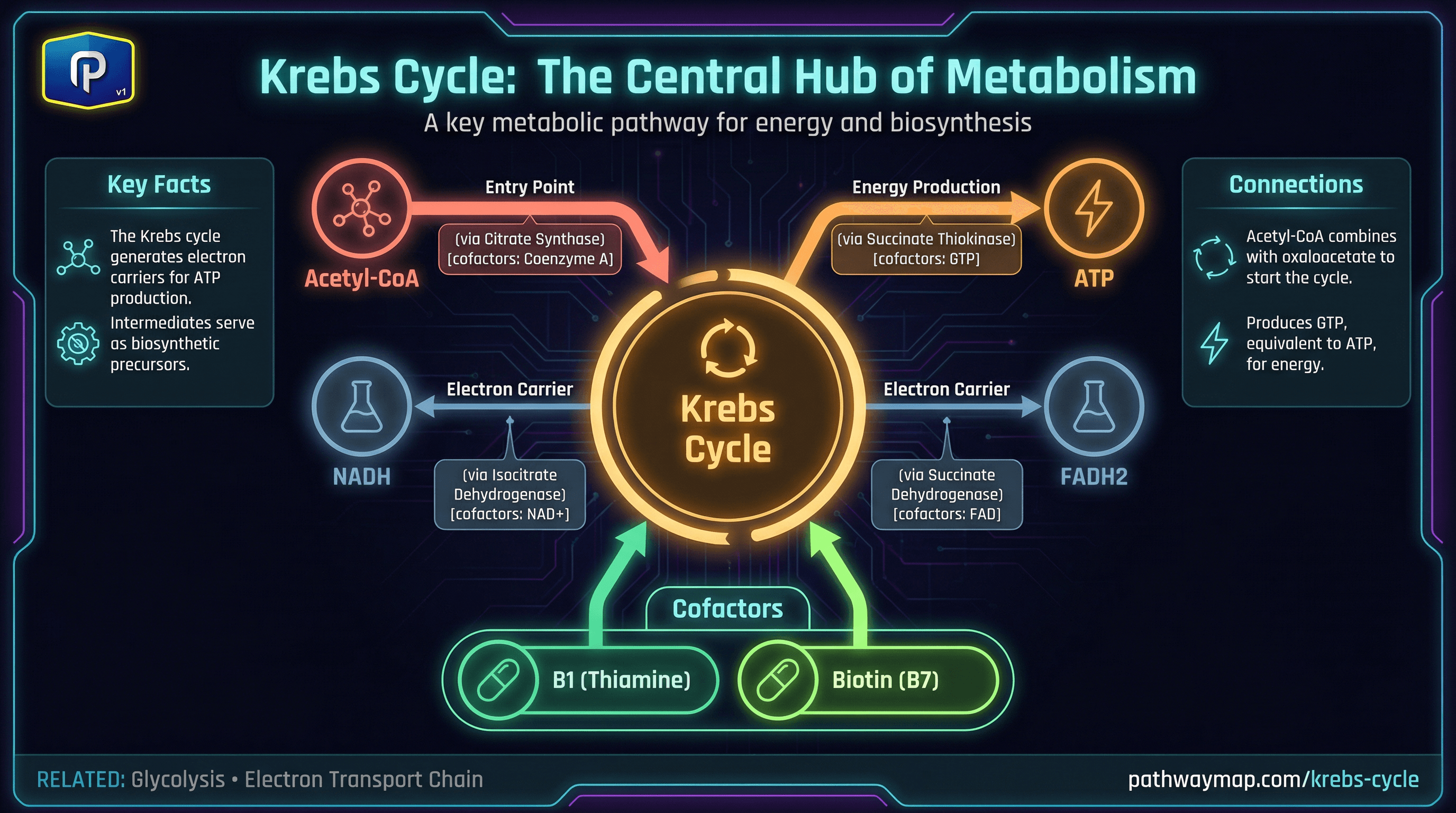
Cycle Overview
Key Regulatory Steps
Citrate Synthase
First step. Acetyl-CoA + OAA → Citrate. Inhibited by ATP, NADH, citrate.
Isocitrate DH
Major control point. Makes first NADH, releases first CO₂. Activated by ADP.
α-Ketoglutarate DH
Second CO₂ release. Requires B1, B2, B3, lipoic acid, CoA. Complex enzyme.
B Vitamin Requirements
Thiamine (B1)
α-ketoglutarate dehydrogenase. Pyruvate dehydrogenase (entry). Critical for cycle.
Riboflavin (B2)
FAD cofactor. Succinate dehydrogenase. Also part of ETC Complex II.
Niacin (B3)
NAD⁺ precursor. Three steps make NADH. Essential for cycle function.
Pantothenic Acid (B5)
Part of CoA. Acetyl-CoA entry. Succinyl-CoA step.
Lipoic Acid
α-ketoglutarate DH complex. Works with B vitamins. Antioxidant too.
Magnesium
Many enzyme steps. GTP/ATP require Mg. Isocitrate DH needs Mg.
What Feeds the Cycle?
Carbohydrates
Glucose → Pyruvate → Acetyl-CoA. Via pyruvate dehydrogenase (PDH).
Fats
β-oxidation produces Acetyl-CoA directly. Major fuel source at rest.
Proteins
Amino acids enter at various points. Alanine → pyruvate. Glutamate → α-KG.
Why It Matters
Energy Production
NADH and FADH₂ carry electrons to ETC. Each NADH = ~2.5 ATP. Major energy source.
Biosynthesis Hub
Intermediates make amino acids, nucleotides, heme. Not just catabolic—anabolic too.
Mitochondrial Dysfunction
Cycle impairment = fatigue, neurodegeneration. Critical for brain, heart, muscle.
Cancer Connection
Some cancers have cycle mutations. Warburg effect bypasses normal cycle. Research target.