The master mineral.
Magnesium is a cofactor in over 300 enzymatic reactions. Most people don't get enough.
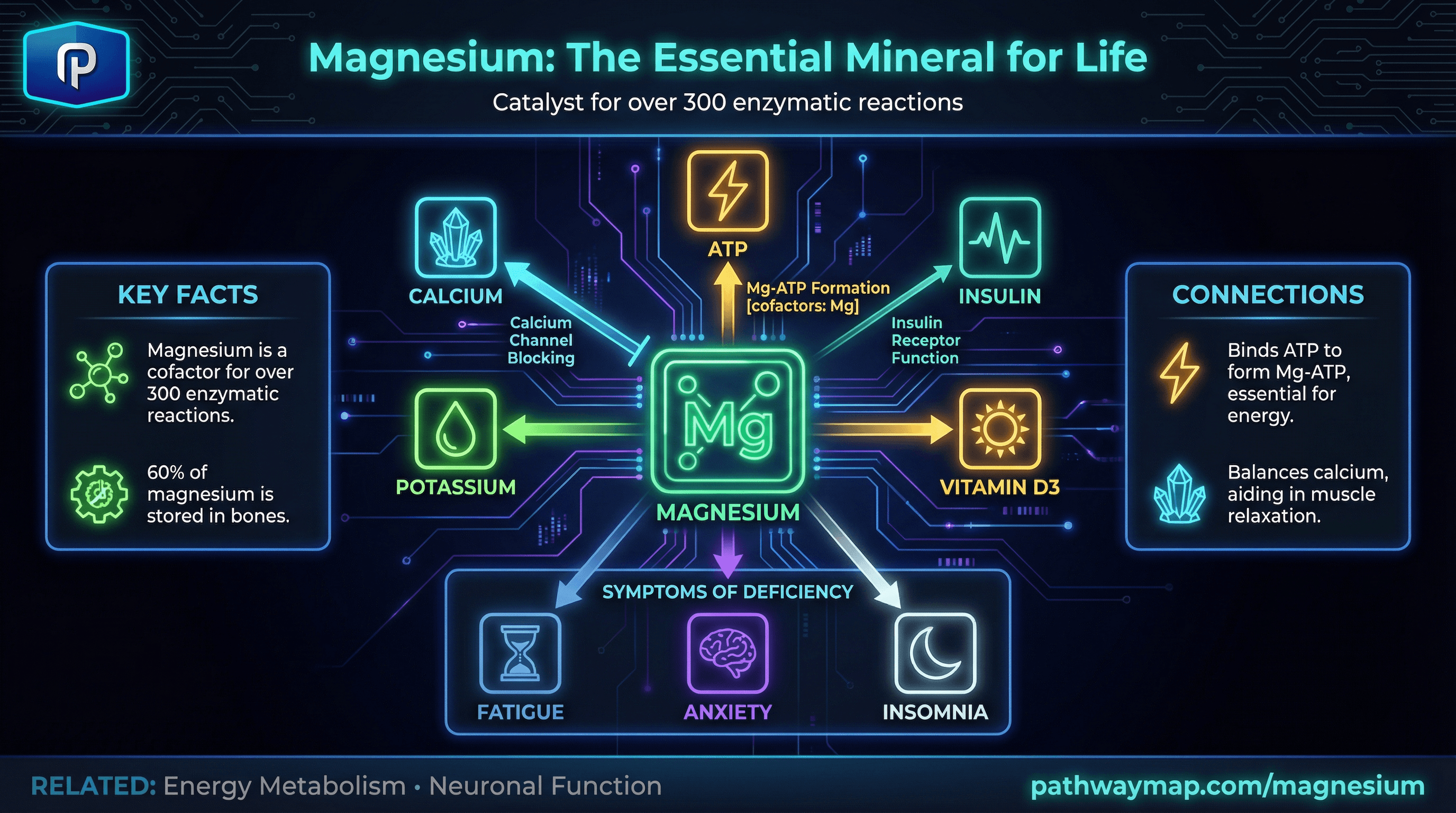
enzymatic reactions require magnesium as a cofactor.
Every molecule of ATP must be bound to magnesium to be biologically active.
What magnesium actually does.
It's not just one thing. Magnesium is fundamental to how your cells work.
Energy production
Every ATP molecule must bind magnesium to work. No magnesium = no cellular energy.
Muscle relaxation
Natural calcium channel blocker. Calcium contracts, magnesium relaxes.
Nerve function
Powers the Na+/K+-ATPase pump that maintains nerve cell electrical gradients.
DNA synthesis
Required for DNA and RNA synthesis. Stabilizes DNA structure itself.
Where magnesium lives in your body.
Long-term storage
Muscles and organs
Serum tests miss deficiency
This is why serum magnesium tests are unreliable. Only 1% is in blood, and your body tightly controls that level by pulling from bones and tissues. You can be severely deficient with "normal" serum levels. RBC magnesium is more accurate.
Different forms for different goals.
Magnesium Glycinate
Best for: Sleep, anxiety, relaxation. Glycine adds calming effect. Well absorbed, gentle on stomach. Top choice for most people.
Magnesium Malate
Best for: Energy, muscle pain, fibromyalgia. Malic acid supports ATP production. Good daytime option.
Magnesium Threonate
Best for: Brain, cognition, memory. Crosses blood-brain barrier effectively. Lower elemental magnesium but targeted delivery.
Magnesium Citrate
Best for: Constipation, general supplementation. Well absorbed but promotes bowel motility. Good if you need that effect.
Magnesium Oxide
Avoid for supplementation. Only 4% absorbed. Mainly useful as a laxative. Cheap but ineffective for raising magnesium levels.
Why you're probably low.
Stress
Cortisol increases urinary magnesium excretion. Chronic stress drains magnesium, and low magnesium worsens stress response. Vicious cycle.
PPIs (Proton Pump Inhibitors)
Block stomach acid, which is needed for mineral absorption. Long-term use causes significant magnesium depletion.
Diuretics
Increase urinary excretion. Both loop and thiazide diuretics cause magnesium wasting. Often prescribed without replacement.
Alcohol
Increases kidney excretion, reduces absorption, and depletes through vomiting. Heavy drinkers are almost always deficient.
Soil Depletion
Modern farming has depleted soil magnesium. Food contains less than it did 50 years ago, even if you eat well.
Processed Foods
Refining removes magnesium. White flour has lost 85% of the magnesium from whole wheat.
Signs you might be deficient.
What magnesium connects to.
Vitamin D
Magnesium is required to convert vitamin D to its active form. Without magnesium, vitamin D supplementation can be ineffective or even harmful.
Calcium
Magnesium balances calcium. Calcium contracts muscles, magnesium relaxes them. Too much calcium without magnesium can cause problems.
Potassium
Magnesium is required for cells to retain potassium. Magnesium deficiency causes potassium wasting no matter how much potassium you take.
COMT Enzyme
Magnesium is a cofactor for COMT, which breaks down stress hormones. Low magnesium means slower clearance of dopamine, norepinephrine, and adrenaline.
ATP (Energy Currency)
ATP must bind magnesium (Mg-ATP) to be biologically active. All 300+ reactions using ATP are actually using Mg-ATP.
Videos, studies & resources
Browse all 6 in the Library →“Magnesium is effective for mild-to-
“Magnesium is effective for mild-to- moderate depression in adults. It works quickly and is well tolerated without the need for close monitoring for toxicity.”
Open ↗Altered magnesium balance can be
Altered magnesium balance can be found in diabetes mellitus, chronic renal failure, nephrolithiasis, osteoporosis, aplastic osteopathy, and heart and vascular disease.
Open ↗amzn.to
crrnt.app
whyiodine.com
whyiodine.com