Not really a vitamin.
Vitamin D is a steroid hormone that regulates thousands of genes. Your body makes it from sunlight.
of people are insufficient
It's a pandemic deficiency.
genes regulated
About 5% of the human genome.
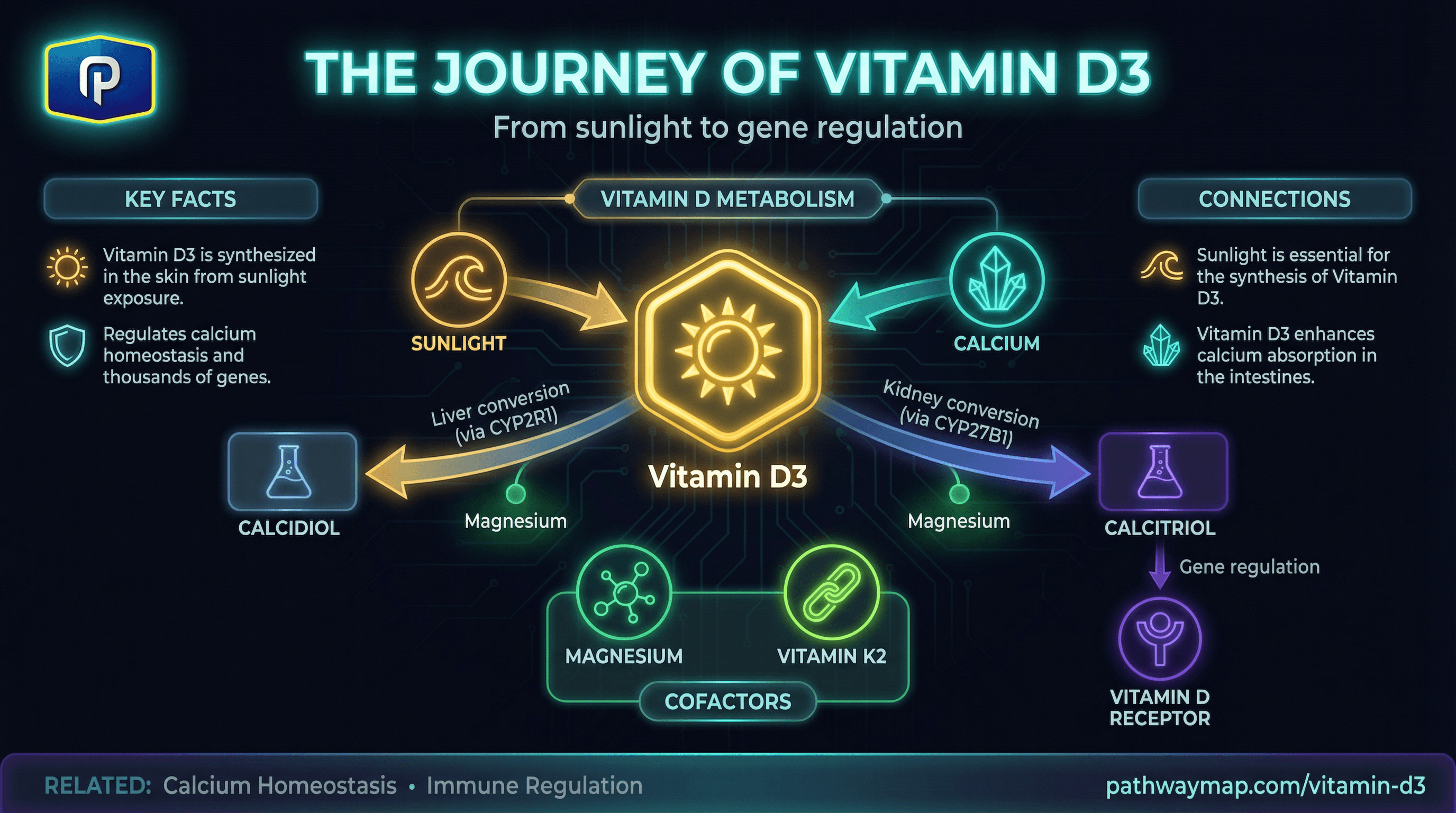
How vitamin D becomes active.
Skin + UVB → Vitamin D3
7-dehydrocholesterol in skin converts to D3 (cholecalciferol) when exposed to UVB rays.
D3 → 25(OH)D (Calcidiol)
This is what blood tests measure. Requires magnesium. Half-life ~2-3 weeks.
25(OH)D → 1,25(OH)₂D (Calcitriol)
The active hormone. Also produced locally in many tissues. Requires magnesium.
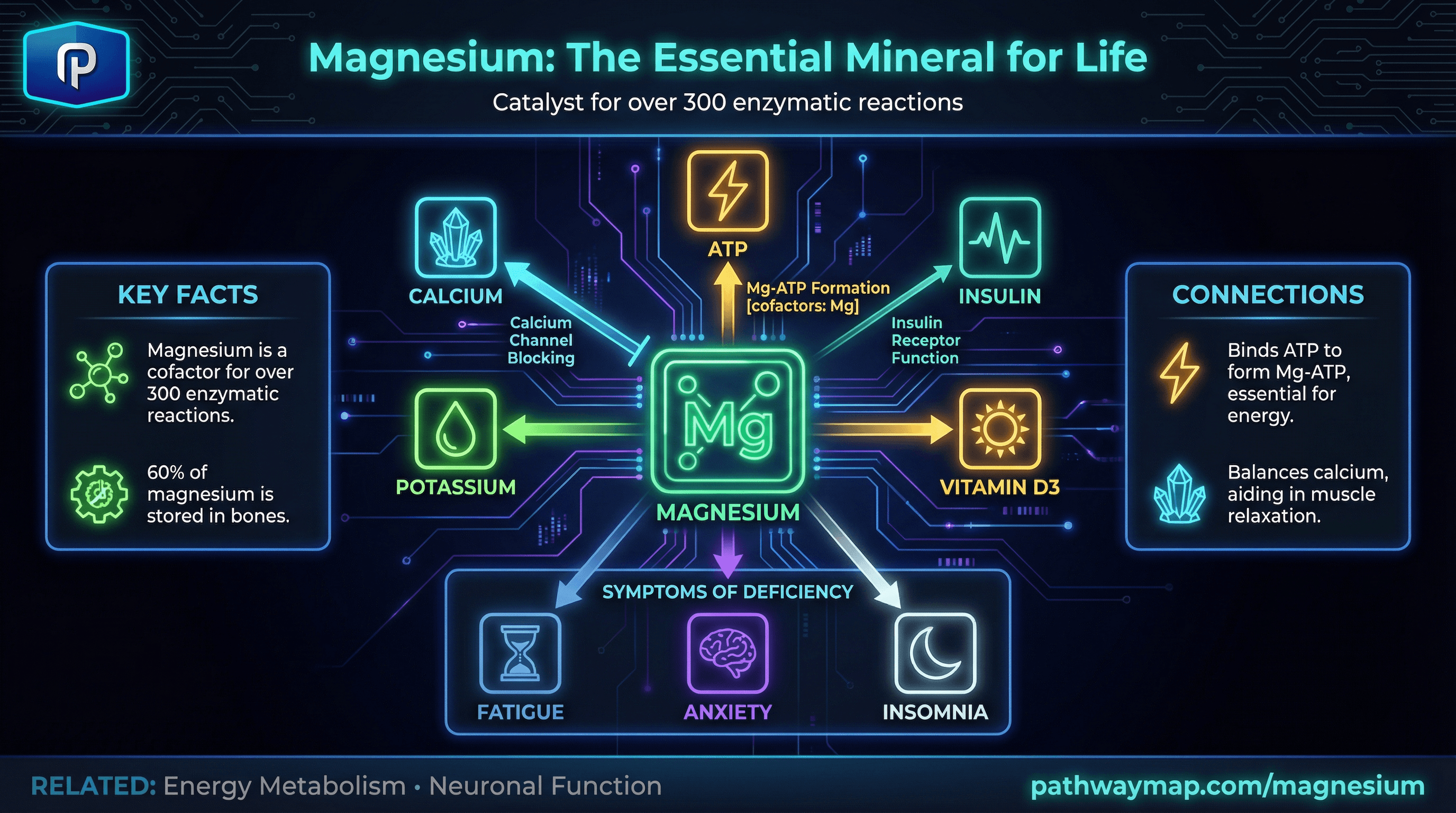
Magnesium is required at both conversion steps. Without adequate magnesium, vitamin D supplementation may be ineffective. This is why some people don't respond to vitamin D—they're actually magnesium deficient.
What vitamin D actually does.
Bone Health
Regulates calcium and phosphorus absorption. Deficiency causes rickets (children) and osteomalacia (adults).
Immune Function
Activates antimicrobial peptides. Modulates immune response. Deficiency increases infection risk.
Brain & Mood
Vitamin D receptors throughout the brain. Low levels linked to depression and cognitive decline.
Muscle Function
Needed for muscle strength and coordination. Deficiency causes weakness and increases fall risk.
Cell Differentiation
Helps cells mature properly. May protect against certain cancers by promoting normal cell behavior.
Cardiovascular
Involved in blood pressure regulation and heart function. Deficiency associated with heart disease.
Optimal ranges are debated.
Test: 25(OH)D (not 1,25-OH₂D)
Note: Conventional medicine often considers 30 ng/mL adequate. Many functional practitioners aim for 40-60 ng/mL.
Vitamin D doesn't work alone.
Magnesium
Required to activate vitamin D at both conversion steps. Without magnesium, vitamin D can't work properly.
Vitamin K2
Directs calcium to bones and teeth instead of soft tissues. Prevents arterial calcification. Essential partner to vitamin D.
Vitamin A
Works with vitamin D at the receptor level. They share the RXR receptor. Balance between the two matters.
Zinc
Needed for vitamin D receptor function. Deficiency impairs vitamin D's ability to act on genes.
Why you're probably low.
Indoor Lifestyle
Most people spend 90%+ of time indoors. No UVB exposure = no vitamin D production.
High Latitude
Above ~35° latitude, UVB is too weak in winter to produce vitamin D regardless of sun exposure.
Dark Skin
Melanin blocks UVB. Darker skin requires 3-5x more sun exposure to produce the same vitamin D.
Obesity
Vitamin D is fat-soluble and gets trapped in adipose tissue. Higher body fat = lower blood levels.
Aging
Skin produces less vitamin D with age. A 70-year-old makes ~25% of what a young person makes.
Sunscreen
SPF 15 blocks ~95% of UVB. Necessary for skin protection, but also blocks vitamin D production.