Vitamin B12
The cobalt-containing vitamin essential for methylation, nerve function, DNA synthesis, and red blood cell formation. Complex absorption makes deficiency common.
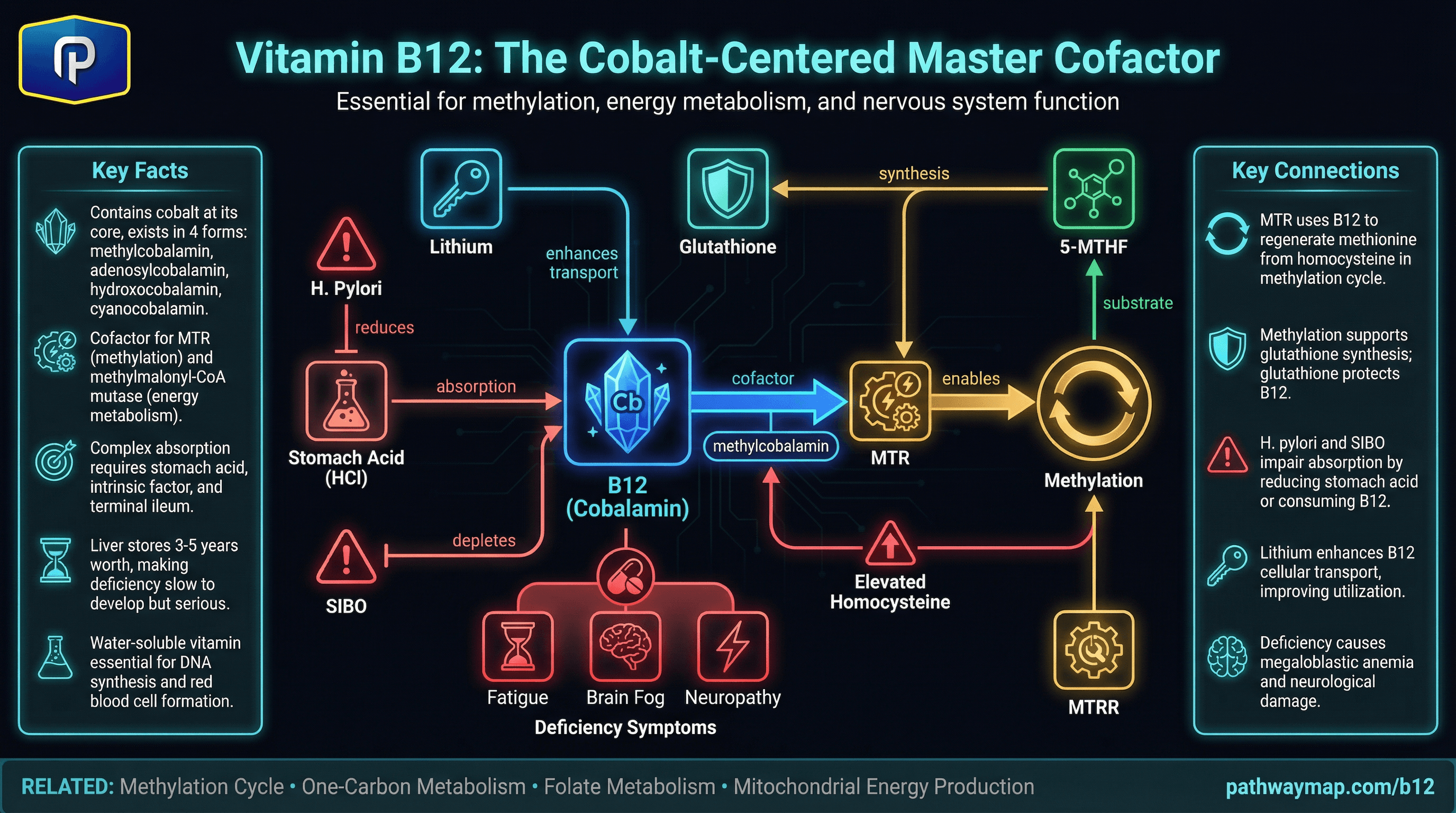
💎 The Four Forms of B12
Not all B12 is created equal. Each form has different roles and bioavailability:
Methylcobalamin
Active in cytoplasm. Methyl donor for methylation cycle (MTR enzyme). The body converts other B12 forms as needed.
Adenosylcobalamin
Active in mitochondria. Required for energy metabolism and processing certain fats/amino acids.
Hydroxocobalamin
Storage and transport form. Converts to active forms as needed. Good for injections; detox support.
Cyanocobalamin
Synthetic form. Requires conversion. Releases small amount of cyanide. Cheapest but least preferred.
🔴 Two Critical Enzymes
Methionine Synthase (MTR)
Uses methylcobalamin to convert homocysteine back to methionine. This is the methylation cycle's connection to B12.
Deficiency → High homocysteine, impaired methylation
Methylmalonyl-CoA Mutase
Uses adenosylcobalamin in mitochondria to process certain fats and amino acids for energy.
Deficiency → Elevated MMA, neurological symptoms
🧬 Complex Absorption
Stomach acid releases B12 from food proteins
R-proteins (haptocorrins) bind B12 in stomach
Pancreatic enzymes release B12 from R-proteins
Intrinsic factor (from parietal cells) binds B12
Terminal ileum absorbs the IF-B12 complex
Any disruption in this chain → B12 deficiency
⚠️ Who's at Risk for B12 Deficiency?
Vegans/Vegetarians
B12 is only found naturally in animal foods. Supplementation essential.
Older Adults
Reduced stomach acid and intrinsic factor production with age.
Pernicious Anemia
Autoimmune destruction of parietal cells—no intrinsic factor.
SIBO
Bacteria in small intestine consume B12 before absorption.
H. Pylori
Reduces stomach acid needed for B12 release from food.
Metformin Users
Long-term use interferes with B12 absorption in the ileum.
PPI/Antacid Users
Reduced stomach acid impairs B12 release from food proteins.
Gastric Bypass
Reduced stomach capacity and bypassed absorption sites.
Crohn's Disease
Inflammation or resection of terminal ileum impairs absorption.
🚨 Signs of B12 Deficiency
Neurological
- • Tingling, numbness in hands/feet
- • Balance problems, difficulty walking
- • Memory problems, cognitive decline
- • Depression, mood changes
- • Subacute combined degeneration (severe)
Blood & Other
- • Megaloblastic anemia (large red blood cells)
- • Fatigue and weakness
- • Glossitis (smooth, red tongue)
- • Elevated homocysteine
- • Elevated MMA (methylmalonic acid)
Warning: Neurological damage can be irreversible if deficiency is prolonged. Don't wait for anemia— neurological symptoms can precede blood changes.
🧪 Testing for B12 Status
Serum B12
Standard test but can be normal even with functional deficiency. "Normal" range is too broad.
Optimal: >500 pg/mL (not just >200)
Methylmalonic Acid (MMA)
More sensitive marker. Elevated MMA indicates functional B12 deficiency at the cellular level.
Should be low/normal if B12 is adequate
Homocysteine
Elevated with B12, folate, or B6 deficiency. Less specific but useful in combination.
Optimal: <8 μmol/L
Holotranscobalamin
Active B12 fraction—the portion actually available to cells. Most accurate but less available.
Better early indicator than serum B12
Metabolic Connections

MTHFR
B12 works with methylfolate to power the methylation cycle

Folate
Methyl trap—without B12, folate gets stuck as methylfolate

Homocysteine
B12 is required to recycle homocysteine back to methionine

Methylation
Methylcobalamin is a direct methyl donor in the methylation cycle

SAM-e
The methylation cycle B12 supports produces SAM-e

Lithium
Lithium enhances B12 transport into cells