Collagen
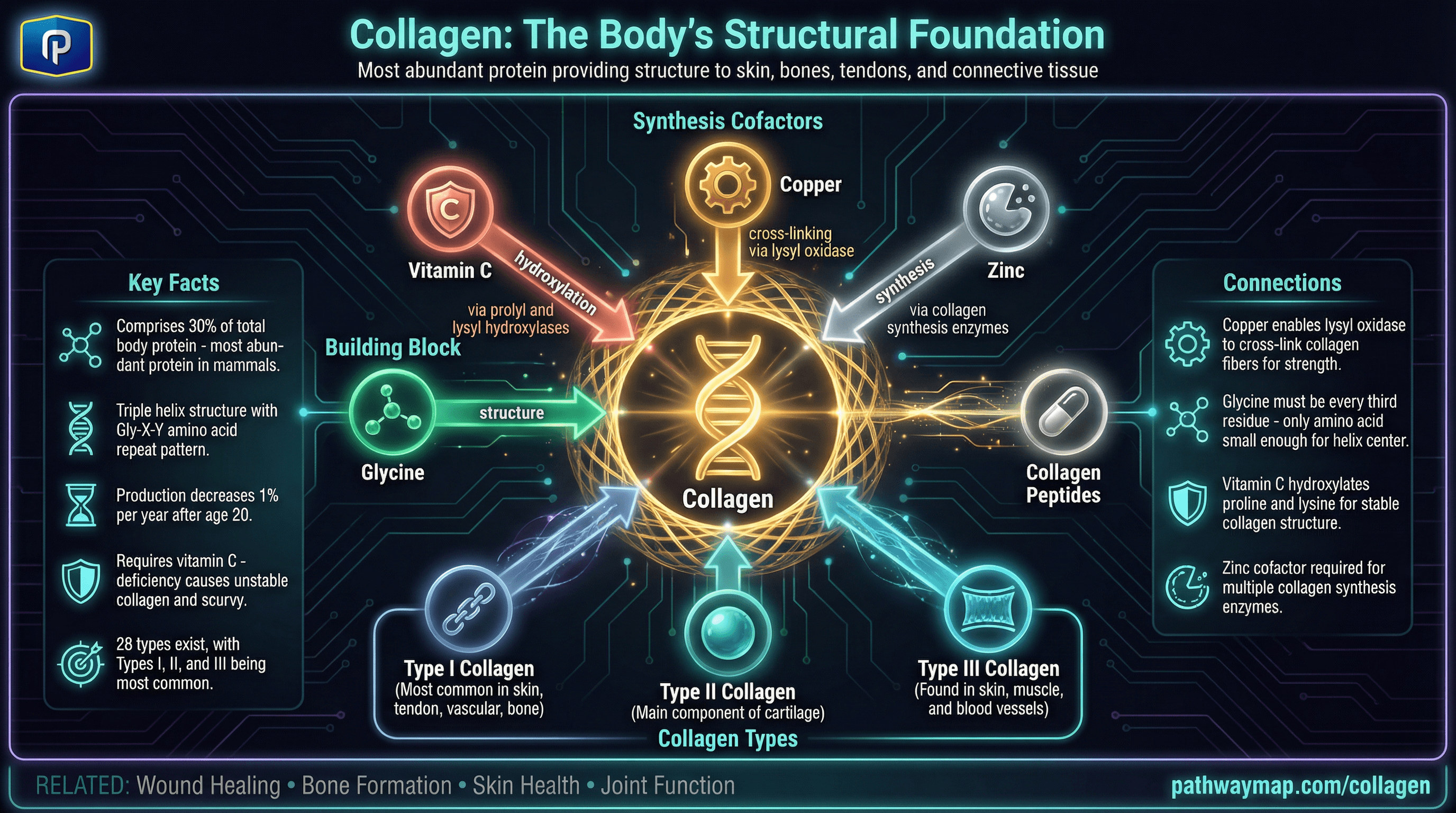
The body's scaffolding. Collagen makes up 30% of your body's protein, providing structure and strength to skin, bones, tendons, ligaments, and organs. There are 28 types, with Types I, II, and III being most abundant. Production drops ~1% per year after age 20—visible as wrinkles, joint stiffness, and slower healing.
Main Collagen Types
Type I (90%)
Skin, bones, tendons, ligaments, teeth. Most abundant. Provides tensile strength.
Type II
Cartilage. Provides resistance to pressure. Joint health focus.
Type III
Blood vessels, intestines, uterus. Supports organs. Often found with Type I.
Type IV
Basement membranes. Forms sheets rather than fibers. Kidney, skin layers.
Type V
Hair, placenta, cell surfaces. Regulates fiber diameter.
Type X
Bone formation and healing. Growth plate cartilage.
What Collagen Needs
Essential Nutrients
- Vitamin C: Absolutely required. Cofactor for hydroxylation.
- Glycine: Every third amino acid in collagen.
- Proline: Key structural amino acid.
- Lysine: For crosslinking and strength.
- Copper: Lysyl oxidase needs it for crosslinks.
What Destroys Collagen
- UV exposure: Sunlight breaks down collagen fibers.
- Sugar: Glycation damages collagen (AGEs).
- Smoking: Reduces blood flow, increases breakdown.
- Chronic inflammation: MMPs break down collagen.
- Cortisol: High stress = collagen breakdown.
Collagen Supplementation
Hydrolyzed Collagen
Broken down into peptides. Better absorption. Studies show skin and joint benefits.
Bone Broth
Traditional source. Contains collagen plus minerals. Glycine-rich. Gut-healing.
Marine Collagen
From fish. Smaller peptides = better absorption. Primarily Type I.
UC-II (Undenatured Type II)
For joints. Works via immune tolerance. Different mechanism than hydrolyzed.