Copper
Essential trace mineral for energy, iron metabolism, and neurotransmitter synthesis—but one that requires careful balance with zinc. Both deficiency and excess cause problems.
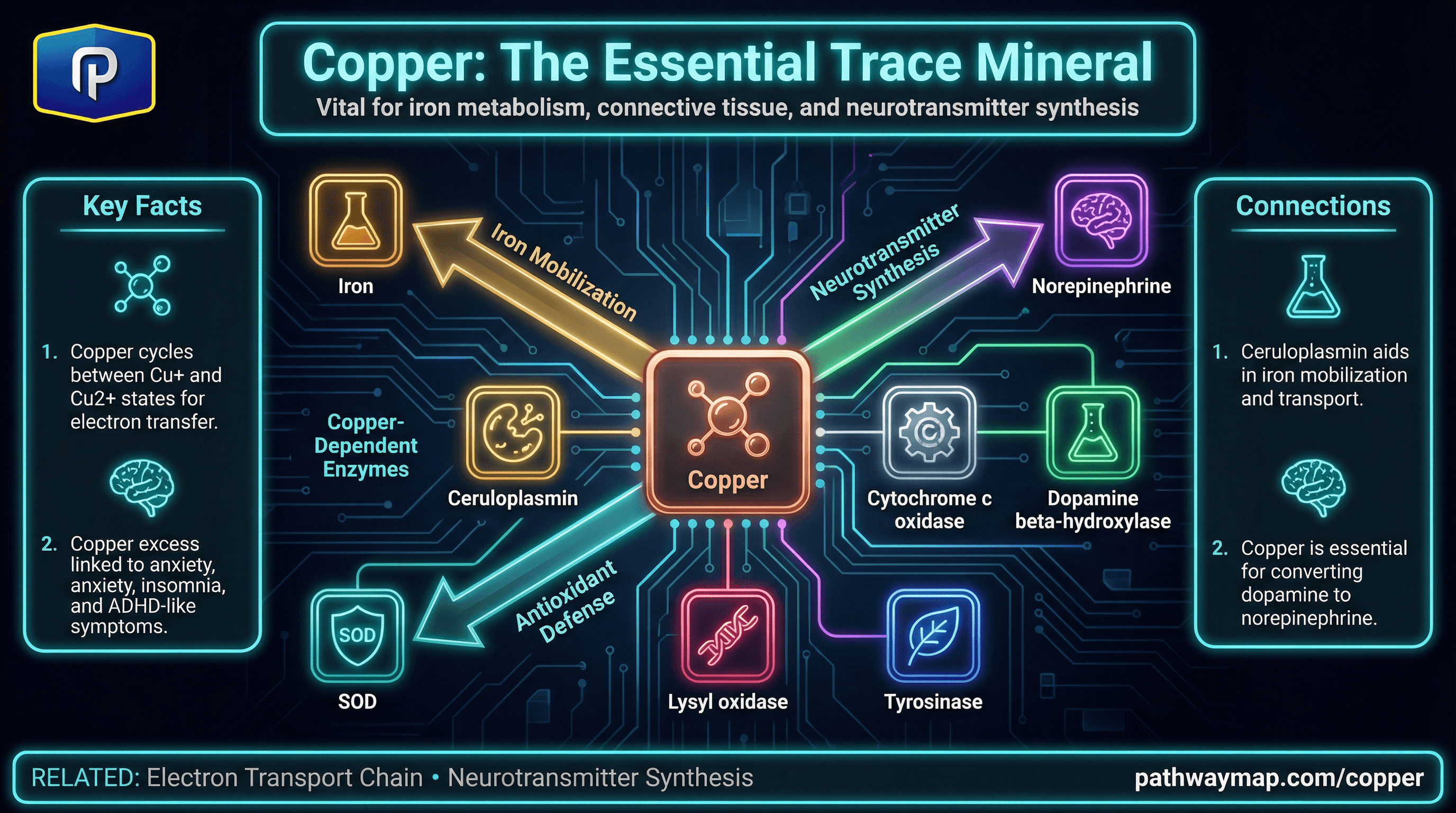
⚙️ Copper-Dependent Enzymes
Copper's ability to cycle between Cu⁺ and Cu²⁺ makes it essential for electron transfer reactions:
Ceruloplasmin
Oxidizes iron for transport. Low = iron trapped in tissues. Called ferroxidase activity.
Cytochrome c Oxidase
Complex IV of electron transport chain. Final step of ATP production.
Cu/Zn-SOD
Superoxide dismutase. Critical antioxidant that neutralizes superoxide radicals.
Dopamine β-Hydroxylase
Converts dopamine to norepinephrine. Low copper = low norepinephrine.
Lysyl Oxidase
Cross-links collagen and elastin. Deficiency = weak connective tissue, aneurysms.
Tyrosinase
Synthesizes melanin. Copper deficiency can cause premature graying.
⚖️ The Copper-Zinc Balance
Copper and zinc compete for absorption and bind to the same metallothionein proteins. This makes their ratio just as important as absolute levels.
Zinc Excess → Copper Deficiency
- • High-dose zinc supplementation (50mg+) depletes copper
- • Zinc induces metallothionein which traps copper
- • Can cause anemia despite adequate iron
- • Neurological symptoms, neutropenia
Copper Excess → Zinc Depletion
- • Copper IUDs, copper pipes can increase copper load
- • Estrogen increases copper retention
- • Wilson's disease = genetic copper accumulation
- • Anxiety, racing thoughts, insomnia
When supplementing zinc long-term, add copper at a 15:1 ratio (e.g., 30mg zinc + 2mg copper).
🔻 Copper Deficiency Signs
Often from excess zinc or malabsorption:
- • Anemia (despite adequate iron—can't mobilize it)
- • Neutropenia (low white blood cells)
- • Bone abnormalities, osteoporosis
- • Neurological problems (ataxia, neuropathy)
- • Premature graying of hair
- • Connective tissue problems
- • Poor wound healing
- • Fatigue and weakness
🔺 Copper Excess Signs
Often from copper IUDs, pipes, or estrogen:
- • Anxiety, panic attacks
- • Racing mind, insomnia
- • Depression (especially postpartum)
- • ADHD-like symptoms
- • PMS, hormonal issues
- • Nausea, digestive issues
- • Headaches, migraines
- • Brain fog, difficulty concentrating
💊 The Copper-Estrogen Connection
Estrogen increases copper retention while decreasing zinc levels. This helps explain why copper issues are more common in women:
Pregnancy
Copper doubles during pregnancy. May contribute to postpartum depression if not balanced.
Birth Control
Oral contraceptives raise copper. Copper IUDs add more. Consider zinc balance.
Premenstrual
Copper rises in luteal phase with estrogen. May explain PMS anxiety and mood changes.
🧪 Testing Copper Status
Serum Copper
Total blood copper. Can be normal even with dysregulation.
Ceruloplasmin
Copper transport protein. Most serum copper is bound to it.
Free Copper (calculated)
Serum Cu - (ceruloplasmin × 3). High free copper = problem.
Cu:Zn Ratio
Optimal ~0.7-1.0. High ratio = copper excess relative to zinc.
🥗 Food Sources of Copper
Richest Sources
- • Beef liver (highest—one serving = week's RDA)
- • Oysters and shellfish
- • Dark chocolate / cacao
- • Cashews, almonds, seeds
- • Mushrooms (shiitake especially)
Other Sources
- • Spirulina
- • Legumes (lentils, chickpeas)
- • Whole grains
- • Potatoes
- • Copper pipes (adds to water)
Metabolic Connections

Zinc
Compete for absorption—must be balanced (ratio ~1:10-15)

Iron
Ceruloplasmin (copper-dependent) mobilizes iron from storage

Dopamine
Dopamine β-hydroxylase needs copper to make norepinephrine

Glutathione
Cu/Zn-SOD is a key antioxidant enzyme

Histamine
Copper excess associated with high histamine and anxiety

Estrogen
Estrogen increases copper retention—tied to PMS and mood
Related Articles
Videos, studies & resources
Browse all 25 in the Library →Acute and Bilateral Blindness Due
Acute and Bilateral Blindness Due to Optic Neuropathy Associated With Copper Deficiency
Open ↗Copper deficiency
Copper deficiency Myelopathy is the result of compression of the spinal cord and nerve roots caused by inflammation, arthritis, bone spurs and spinal degeneration due to aging.
Open ↗Copper deficiency has been
Copper deficiency has been associated with myeloneuropathy, a condition affecting both the spinal cord and peripheral nerves.
Open ↗Copper deficiency impairs growth of
Copper deficiency impairs growth of infants recovering from malnutrition
Open ↗Copper-phospholipid interaction at cell
Copper-phospholipid interaction at cell membrane model hydrophobic surfaces
Open ↗Copper: from neurotransmission
Copper: from neurotransmission to neuroproteostasis
Open ↗