B2
Riboflavin - critical cofactor for MTHFR, glutathione recycling, and energy production.
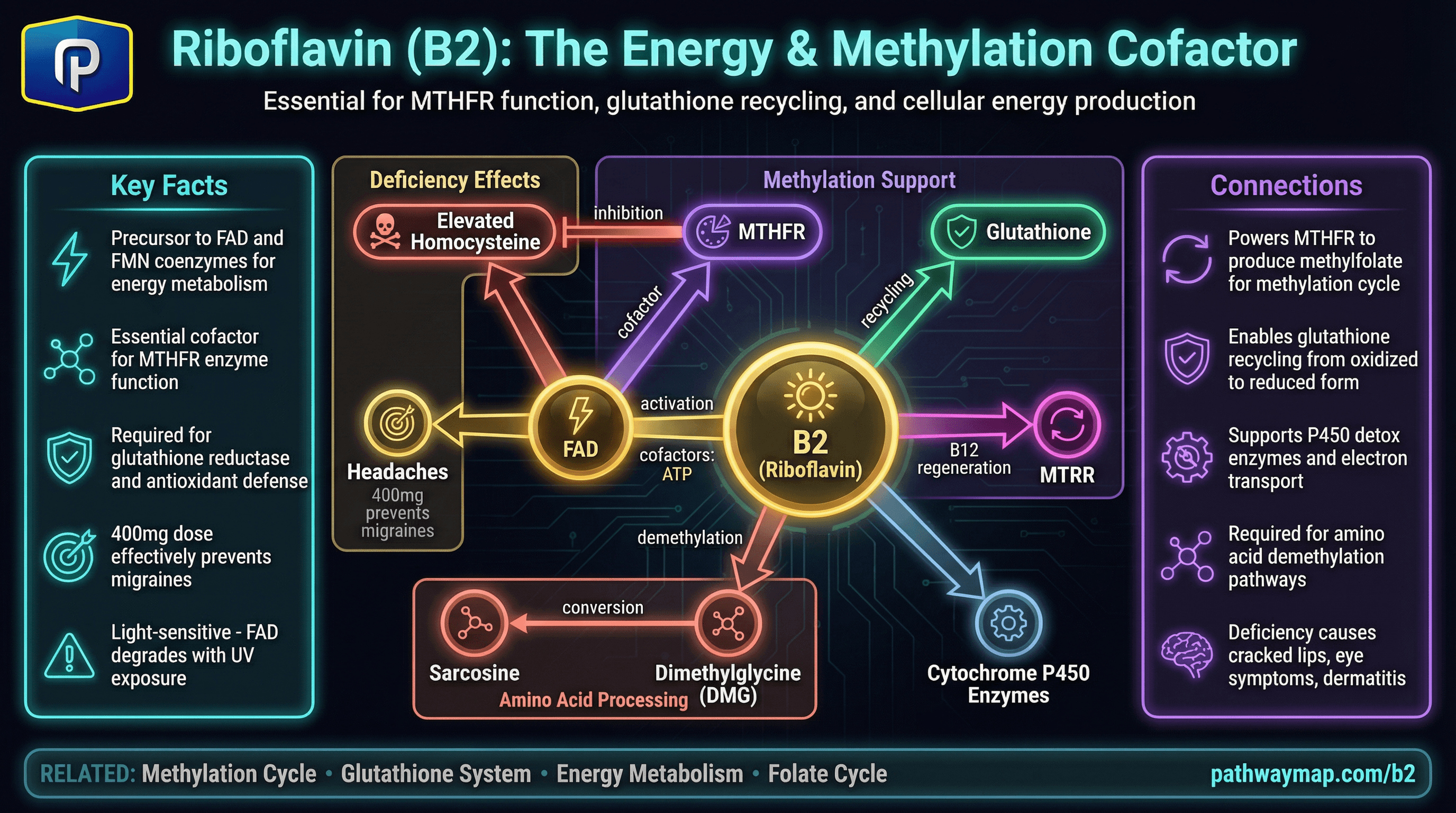
Riboflavin (vitamin B2) is a water-soluble vitamin that serves as a precursor to two essential coenzymes: flavin mononucleotide (FMN) and flavin adenine dinucleotide (FAD).
These are involved in numerous oxidation-reduction reactions in energy metabolism and antioxidant defense.
FAD is the essential cofactor for MTHFR (methylenetetrahydrofolate reductase), the enzyme that produces methylfolate for the methylation cycle.
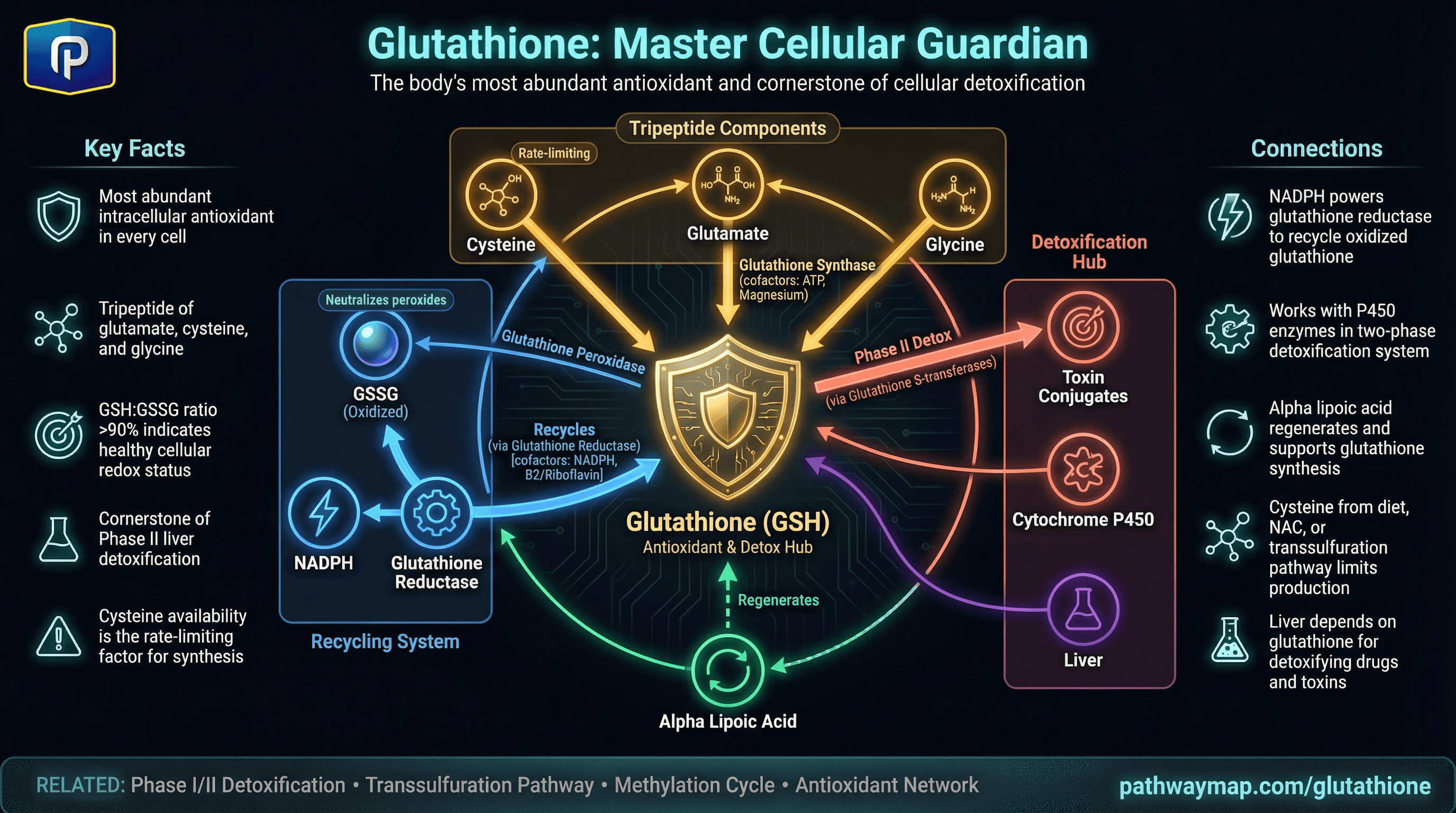
Riboflavin supplementation can improve MTHFR function even in those with genetic variants, making it a key support for methylation. Riboflavin is also required for: glutathione reductase (recycling oxidized glutathione back to reduced form), MTRR (methionine synthase reductase, which regenerates B12), xanthine oxidase (purine metabolism), and multiple complexes in the electron transport chain.
The active form FAD is light-sensitive and degraded by UV exposure. Deficiency causes angular cheilitis (cracked corners of mouth), glossitis, seborrheic dermatitis, and eye symptoms. Riboflavin is used at high doses (400mg) for migraine prevention. Food sources include liver, eggs, dairy, and almonds.
Riboflavin-5-phosphate is the activated form for those with conversion issues.
Metabolic Connections
B2 connects to 21 other pathways.

Enzymes

Cytochrome P450 Enzymes
P450 reductase requires FAD/FMN from riboflavin
Heme-containing enzymes metabolizing drugs, toxins, and hormones; require B vitamins, iron, and proper redox status.
Cytochrome P450 Enzymes
Riboflavin (B2) as FAD/FMN is required for P450 reductase
Heme-containing enzymes metabolizing drugs, toxins, and hormones; require B vitamins, iron, and proper redox status.
Amino Acids

Dimethylglycine (DMG)
DMG dehydrogenase requires FAD for demethylation to sarcosine
Product of betaine demethylation; can donate methyl groups to folate pool; intermediate in choline metabolism.
Dimethylglycine (DMG)
DMG dehydrogenase requires FAD (from B2) as a cofactor
Product of betaine demethylation; can donate methyl groups to folate pool; intermediate in choline metabolism.

Sarcosine (N-Methylglycine)
Sarcosine dehydrogenase requires FAD for demethylation to glycine
Intermediate between DMG and glycine; donates methyl group to folate; elevated in prostate cancer.
Sarcosine (N-Methylglycine)
Sarcosine dehydrogenase requires FAD (from B2)
Intermediate between DMG and glycine; donates methyl group to folate; elevated in prostate cancer.

Lab Findings

Elevated Homocysteine
B2 deficiency impairs MTHFR, elevating homocysteine
High blood homocysteine level; indicates impaired methylation, B12/folate/B6 deficiency, or genetic variants like MTHFR.
Elevated Homocysteine
B2 deficiency impairs MTHFR, reducing 5-MTHF and increasing homocysteine
High blood homocysteine level; indicates impaired methylation, B12/folate/B6 deficiency, or genetic variants like MTHFR.
Cofactors

FAD (Flavin Adenine Dinucleotide)
FAD (flavin adenine dinucleotide) is derived from riboflavin
Coenzyme derived from riboflavin (B2); electron carrier in redox reactions; required by many dehydrogenases.
FAD (Flavin Adenine Dinucleotide)
FAD is synthesized from riboflavin (vitamin B2)
Coenzyme derived from riboflavin (B2); electron carrier in redox reactions; required by many dehydrogenases.
Symptoms

Fatigue
Riboflavin is essential for energy production; deficiency causes fatigue.
Persistent tiredness not relieved by rest; can indicate mitochondrial dysfunction, nutrient deficiencies, or hormonal imbalances.

Headaches
Riboflavin (400mg) reduces migraine frequency
Head pain with many types and causes; migraines often involve magnesium deficiency, histamine, or mitochondrial dysfunction.
Headaches
Riboflavin (400mg) reduces migraine frequency, likely via mitochondrial support
Head pain with many types and causes; migraines often involve magnesium deficiency, histamine, or mitochondrial dysfunction.

Methylation

MTHFR
Riboflavin as FAD is essential cofactor for MTHFR enzyme
Methylenetetrahydrofolate reductase - converts folate to methylfolate for the methylation cycle. Common genetic variants reduce function.
MTHFR
B2 (as FAD) is the essential cofactor for MTHFR enzyme activity
Methylenetetrahydrofolate reductase - converts folate to methylfolate for the methylation cycle. Common genetic variants reduce function.

MTRR
B2 (as FAD) is required for MTRR (methionine synthase reductase) to regenerate active B12
Methionine synthase reductase - regenerates active methylcobalamin for the MTR enzyme.
MTRR
B2 (as FAD) is required for MTRR (methionine synthase reductase) to regenerate active B12
Methionine synthase reductase - regenerates active methylcobalamin for the MTR enzyme.