Anxiety isn't a character flaw.
It's a signal that something in your biochemistry needs attention.
What's happening in your brain
Anxiety involves real changes in brain function and chemistry. It's not weakness—it's biology.
Overactive amygdala
Your brain's fear center fires too easily, seeing threats where there aren't any.
Underactive prefrontal cortex
The rational part of your brain can't override the fear signals effectively.
HPA axis dysregulation
Your stress response system is stuck in overdrive, pumping out cortisol.
Neurotransmitter imbalance
Low GABA, serotonin problems, too much norepinephrine and glutamate.
of your serotonin is made in your gut, not your brain.
This is why digestive issues and anxiety often go together.
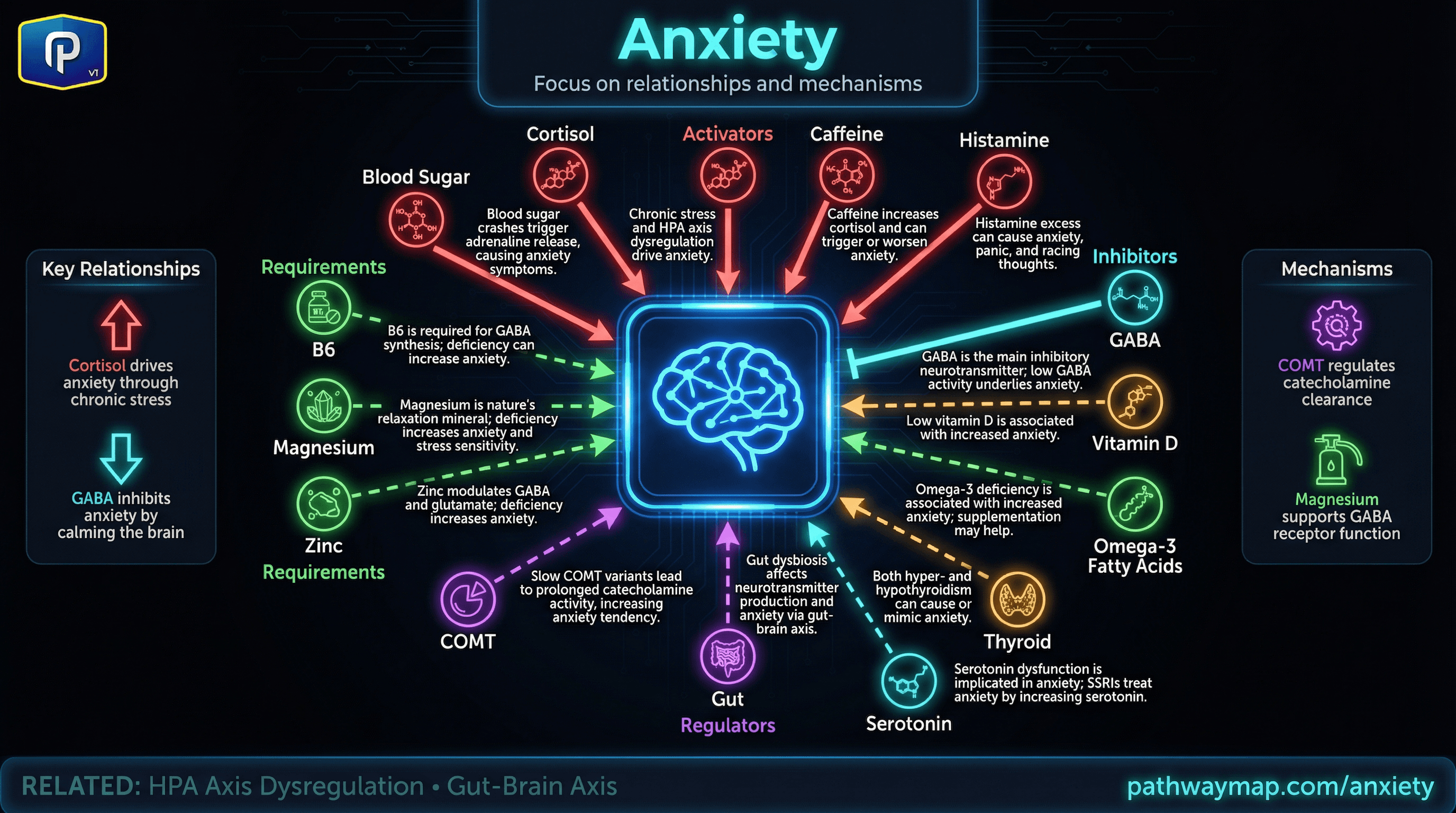
These deficiencies drive anxiety.
Magnesium
Nature's relaxation mineral. Essential for GABA function and calming the nervous system.
Vitamin B6
Required to make GABA. Without enough B6, your brain can't produce calming neurotransmitters.
Zinc
Modulates the balance between GABA (calming) and glutamate (excitatory). Deficiency tips toward anxiety.
Omega-3 Fatty Acids
Critical for brain cell membranes. Deficiency is strongly linked to anxiety and depression.
Vitamin D
More hormone than vitamin. Low levels are consistently associated with anxiety across studies.
Things that make it worse.
Blood sugar crashes
When blood sugar drops, your body releases adrenaline. Same symptoms as a panic attack.
Caffeine
Increases cortisol and blocks adenosine (the calming neurotransmitter). Anxiety in a cup.
Histamine excess
Can cause anxiety, panic attacks, and racing thoughts. Often overlooked.
Poor sleep
Sleep deprivation directly worsens anxiety. They feed each other in a vicious cycle.
Thyroid dysfunction
Both hyper- and hypothyroidism can cause or mimic anxiety symptoms.
Gut dysbiosis
The gut-brain axis is real. Digestive problems often come with mood problems.
Some people are wired for it.
COMT variants (slow)
People with slow COMT clear stress hormones (dopamine, norepinephrine, adrenaline) more slowly. This means anxiety and stress linger longer. The upside? Often better focus and memory.
GAD1 variants
Variations in the gene that makes the enzyme for GABA synthesis. Can reduce your brain's ability to produce calming neurotransmitters.
Where to start.
Check nutrient status. Especially magnesium, B vitamins, zinc, vitamin D, and omega-3s.
Stabilize blood sugar. Track how you feel 2-3 hours after meals. Crashes cause anxiety.
Fix sleep first. Anxiety and poor sleep feed each other. Break the cycle.
Try eliminating caffeine. Just for 2 weeks. See what happens.
Get a full thyroid panel. Not just TSH. Include T3, T4, and antibodies.
Explore the connections.
Anxiety doesn't exist in isolation. See how it connects to other pathways.